Gimbap Recipe
50 minBase: 2 servings
Ingredients
Main ingredients
- Warm cooked short-grain rice350 g
- Full-size roasted gim sheets2 whole
- Fully cooked ham for gimbap60 g
- Large eggs2 whole
- Carrot80 g
- Cucumber80 g
- Danmuji (pickled yellow radish)60 g
Seasonings
- Fine salt0.5 tsp
- Toasted sesame oil2 tsp
- Neutral cooking oil1 tbsp
Ingredient preparation notes
- Warm cooked short-grain rice
For two rolls; cooked weight, not dry rice.
- Fully cooked ham for gimbap
Use a fully cooked product and check the label for soy, wheat, milk, and other allergens.
- Danmuji (pickled yellow radish)
Drain and pat dry, then cut into long strips.
Equipment & measures
- Knife and cutting board
- Kitchen scale and measuring spoons
- Wide frying pan
- Mixing bowl
- Spatula
- Bamboo rolling mat
- Food thermometer
1 tsp = 5ml · 1 tbsp = 15ml. Use measuring spoons.
Prep 30 min · Cook 20 min
Method
The instructions below are for 2 servings.
Prepare cucumber and fillings
Wash cucumber under running water, dry, and cut into long sticks. Remove a soft, watery seed core if necessary. Cut carrot into fine strips and ham and radish into long sticks. Reserve a quarter teaspoon salt for rice and another quarter teaspoon for fillings.
Dry cucumber and cook carrot
Sprinkle half the filling salt over cucumber, wait 5 minutes, and pat away released water. Stir-fry carrot in 1 teaspoon cooking oil for 2–3 minutes with some filling salt. Keep the rest of that salt for eggs.
Make the egg strips
Beat eggs with the remaining filling salt. Cook a thin omelet in 1 teaspoon cooking oil, turning it to set both sides and reach at least 71°C/160°F inside. Cut into long strips.
Heat the ham
Use a fully cooked, ready-to-eat ham product. Turn the strips in the remaining teaspoon cooking oil for 2–3 minutes, heating throughout to 74°C/165°F. Transfer to a clean plate and let heavy steam escape briefly.
Season the rice
Mix warm rice with the reserved quarter teaspoon salt and 1.5 teaspoons sesame oil. Let steam escape briefly without prolonged room-temperature holding. Divide rice and each filling into two portions.
Roll two gimbap
Place gim rough-side up on a clean rolling mat. Spread half the rice thinly, leaving 3 cm clear at the top. Arrange half the fillings across it, wrap the lower edge around them, and roll firmly while pulling the mat clear. Repeat.
Finish and slice
Brush both rolls with the remaining half teaspoon sesame oil. Set seam-side down for 1 minute, then slice 1.5–2 cm thick with a clean, lightly dampened knife. Serve promptly.
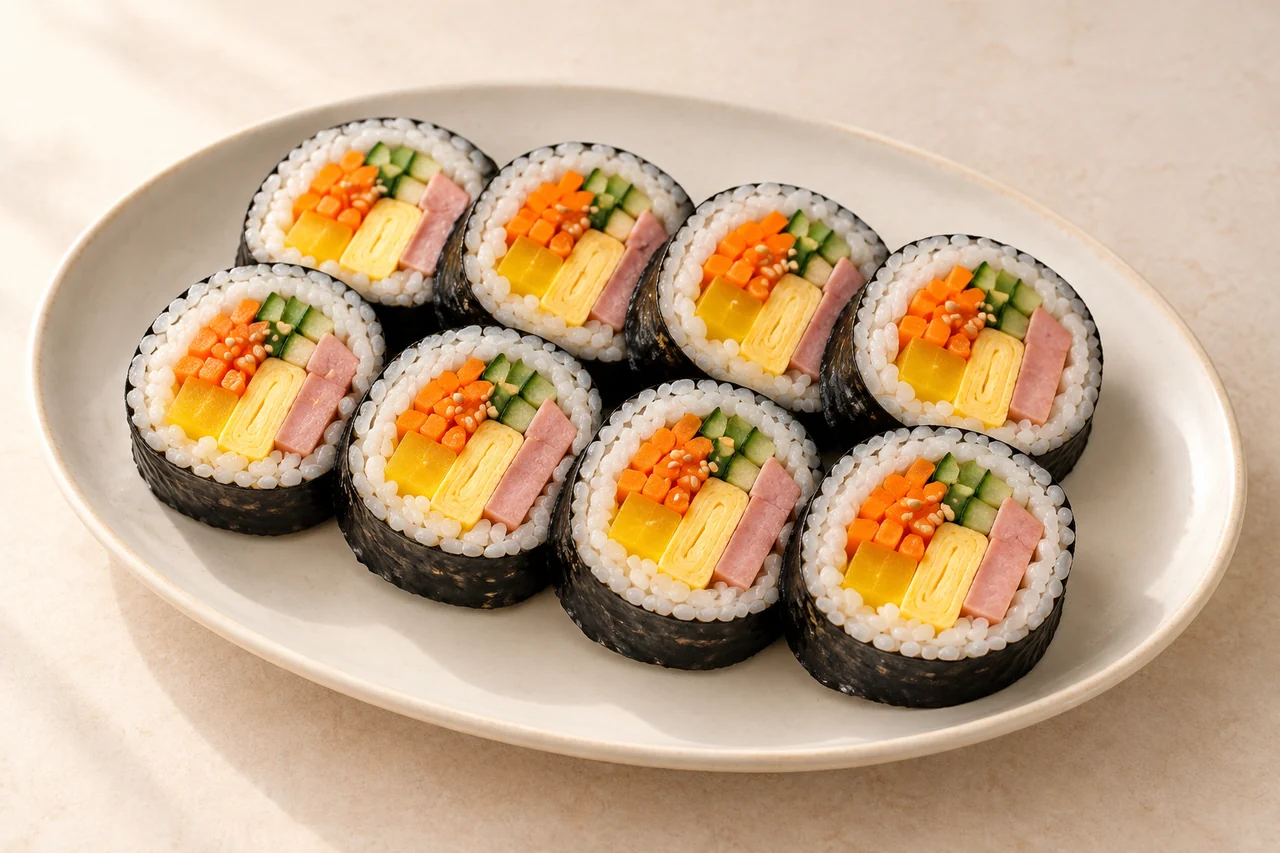
Make two gimbap rolls with ham, eggs, carrot, cucumber, and pickled radish. Dry the fillings, spread rice thinly, and chill finished rolls promptly when storing.
This makes two ham-and-cucumber rolls, one per serving, using rice that is already cooked. Cook the eggs, heat the ham, and remove moisture from the washed cucumber. Let heavy steam escape briefly before rolling without prolonged counter cooling.
A LITTLE KITCHEN WISDOM
Little details that help
Keep fillings relatively dry
Pat away water released by salted cucumber and dry the pickled radish. Wet fillings quickly soften gim. Prepare everything before beginning to roll.
Avoid overfilling
An even, thin rice layer matters more than adding extra filling. Keep pulling the mat away so it does not become trapped inside the roll.
Storing leftovers
Best freshly made. Refrigerate uneaten rolls at 4°C/40°F or below within 1 hour and use within 24 hours. Eat chilled or reheat once to 74°C/165°F inside. Reheating does not rescue rice held unsafely.
Common questions
Must I remove the cucumber seeds?
A small firm cucumber can be used as it is. If the core is soft and watery, remove it before weighing the 80 g used in the recipe.
Can I leave morning-made gimbap out until lunch?
Do not hold it at room temperature for hours. Chill promptly and transport in an insulated bag with ice packs so it remains cold until eating.